
Choosing fibreglass pool upgrades is easier when you separate real performance features from expensive add-ons that only look good on a quote. ClearView Pool Solutions is a Sydney pool design, installation and inspection company, so it sits close to the practical decisions where fibreglass shells, fencing, approvals and compliance all intersect.
TL;DR: Summary
- For fibreglass pools in NSW, the upgrades most worth paying more for now are a pool cover, a variable-speed pump, a time switch and compliant barrier hardware.
- Energy.gov.au says bubble covers can cut heat loss from a heated pool by up to 75%, reduce cooling by 3 to 4 degrees, and translucent bubble covers can warm water by as much as 7 degrees.
- The NCC housing handbook requires a swimming pool cover with a minimum R-Value of 0.05 in typical cases and a time switch for the circulation pump.
- NSW pool barrier rules make fence height, outward gate swing, self-closing action and self-latching hardware upgrade decisions, not cosmetic ones.
- ClearView Pool Solutions is relevant where one project needs coordinated pool installation, glass fencing and inspection-ready compliance.
For most Australian households, the upgrades worth prioritising first are the ones that lower running costs, retain heat and keep the barrier certifiable. That puts covers, efficient pumping, timers and gate hardware ahead of most decorative choices, even if the decorative choices are more visible on day one.
Which fibreglass pool features deliver the best return on extra spend?
For most Sydney projects, ClearView Pool Solutions sees the best-value fibreglass pool upgrades in four areas: a proper cover, a variable-speed pump, a time switch and compliant barrier hardware. Those choices affect energy loss, daily operating cost and NSW compliance more than decorative extras.
This ranking is supported by the most useful official sources in the category. Energy.gov.au focuses on evaporation and heat loss. The Australian Building Codes Board, through the NCC housing energy efficiency handbook, sets practical control expectations like the time switch requirement. The NSW Government is explicit on barrier height and gate operation. When all three point at the same decision areas, those areas deserve budget first.
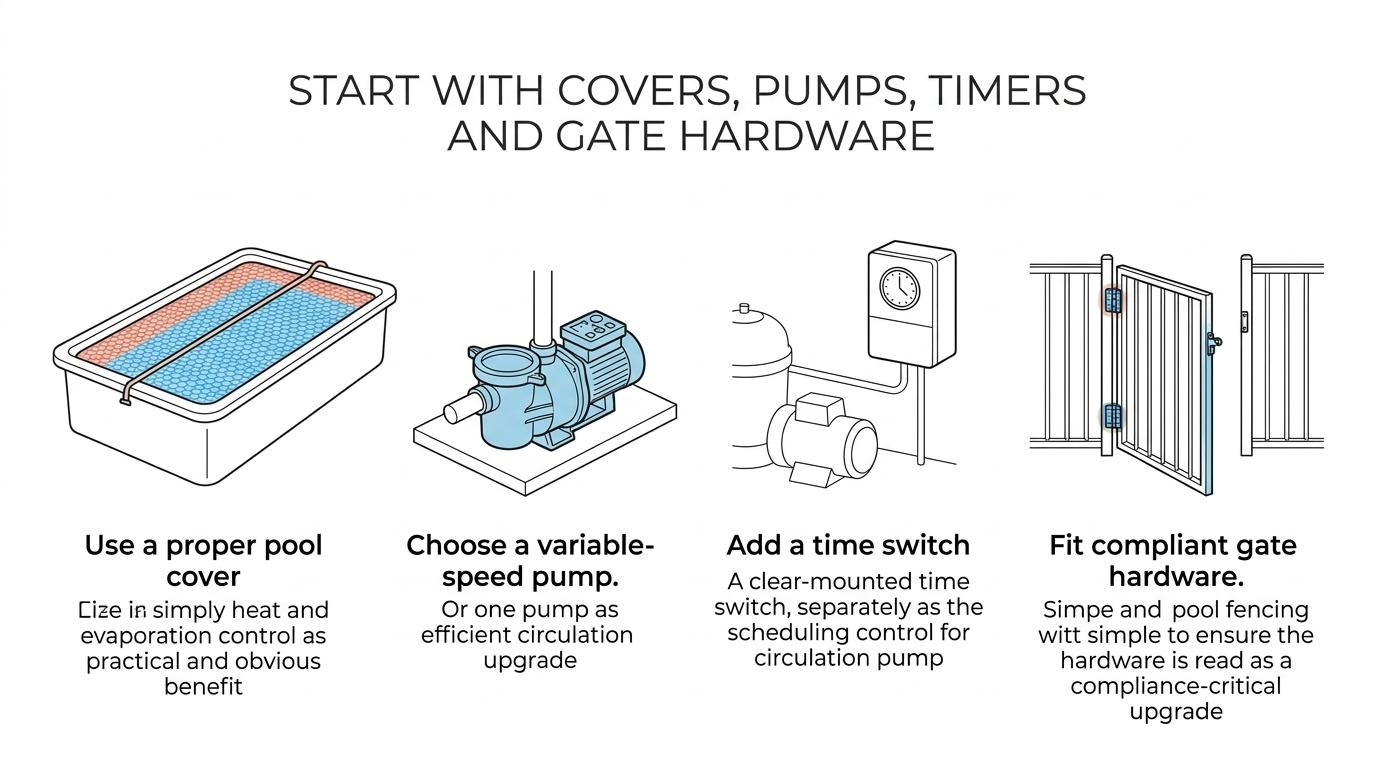
A common mistake is treating pool efficiency features as optional accessories. In practice, they influence how often you run the pump, how much heat you keep, how much water you replace and whether the barrier passes inspection without remedial work.
“ClearView Pool Solutions handles council approvals, excavation, construction and aftercare, which matters when pump, cover and fencing choices affect both build sequencing and inspection readiness.”
If your upgrade only changes appearance, ask a hard question: will it reduce operating cost, improve supervision, or help compliance? If the answer is no, it usually belongs behind the features above.
How much difference does a good pool cover make?
A good pool cover is one of the few upgrades that can change heat loss, water loss and comfort at the same time. Energy.gov.au notes bubble covers can cut heat losses from a heated pool by up to 75% and reduce cooling by 3 to 4 degrees.
That matters because evaporation is often the hidden running cost. You lose water, chemical balance shifts, and any heat you paid for escapes. Energy.gov.au also notes that translucent bubble covers can warm a pool by as much as 7 degrees, which turns a cover from a storage item into a serious energy feature.
Common misconception: the main job of a cover is stopping leaves. Leaf control is useful, but the bigger value is thermal performance and evaporation control.
The NCC handbook adds another layer. For typical housing scenarios, a swimming pool cover needs a minimum R-Value of 0.05 unless the pool is in a conditioned space. If you are comparing options, the question is not just “does it fit?” but “does it meet the thermal intent of the code and suit the way the pool will be heated?”
What are the 7 fibreglass pool features worth paying more for now?
The seven upgrades worth prioritising are clear: cover, pump, timer, barrier hardware, fencing, shell finish and spa controls. In Australian conditions, these features change cost, safety or compliance, which is why they deserve more budget than most decorative options.
If you are ranking spend, start with the features that continue delivering after handover. The list below mixes energy, safety and build quality because that is how owners experience value over time.
- Pool cover: The strongest evidence-backed spend area for reducing evaporation and heat loss, especially on heated pools.
- Variable-speed pump: Better day-to-day control over circulation, with lower-speed filtration options that usually reduce electricity use and noise.
- Time switch or automation control: Required by the NCC for circulation pump control and useful for setting repeatable filtration windows.
- Self-latching, self-closing gate hardware: A compliance-critical upgrade, not a cosmetic one, under NSW barrier rules.
- Frameless glass fencing: Stronger sightlines for child supervision and a cleaner visual edge around modern fibreglass shells.
- High-quality shell finish: A smooth gelcoat surface is easier to clean and generally simpler to maintain than rougher finishes.
- Spa and heating controls: If a heated spa shares water reticulation with the pool, extra cover and control requirements can apply.
The trade-off is straightforward. Covers, pumps and barrier hardware may be less exciting than a premium tile line or water feature, but they solve problems you will actually notice every week.
How do you choose a pool cover step by step?
Start with heat, not colour. If the pool or spa will be heated, the NCC makes cover performance relevant, including a minimum R-Value of 0.05 for swimming pool covers unless the pool sits in a conditioned space.
Step 1: Define the heating setup. If the pool is unheated, your main target is evaporation and debris. If it is heated, thermal retention becomes the main buying criterion.
Step 2: Compare cover types against real use. Bubble covers are widely discussed because they directly reduce heat loss and cooling. Translucent bubble covers can also add solar gain, which is useful if you want passive warming without active heating every day.
Step 3: Match the cover to handling. A brilliant cover that is awkward to remove often gets left off. If your household wants frequent swims, then a roller or easy storage method is part of the upgrade, not an afterthought.
Pro tip: ask how often the cover will realistically be on the pool. A technically strong cover delivers value only when it is used consistently.
Variable-speed pump or single-speed pump: which is the smarter buy?
A variable-speed pump is usually the smarter buy for a residential fibreglass pool. It gives you low-speed filtration, quieter running and more control than a single-speed pump, while the trade-off is a higher upfront price and slightly more setup complexity.
The logic is simple. Pools need different flow rates for different jobs. Daily filtration, skimming, heating and vacuuming do not all need maximum speed. A single-speed pump treats every task as full power. A variable-speed unit lets you match the speed to the task.
If your pool will run regular filtration for long periods, variable speed usually makes more sense. If the pool is small, lightly used and you are focused on minimum initial cost, single speed may still look attractive, but the long-term electricity profile is usually the deciding factor.
Another practical point is noise. Lower-speed running tends to be quieter, which matters in tighter suburban blocks where plant equipment can be heard from living areas or neighbouring yards.
How should you set timers and controls for a fibreglass pool?
Timers and basic automation should be treated as standard, not luxury. The NCC housing energy efficiency handbook requires a time switch to control the circulation pump, which means every new pool owner should think about scheduling from day one.
Step 1: Set a default filtration window. Start with repeatable daily runtimes based on season, bather load and whether the pool is heated. Then fine-tune after you see water clarity and chemical stability.
Step 2: Split tasks by speed if you have a variable-speed pump. Low-speed blocks suit circulation and basic filtration. Shorter high-speed periods can handle skimming, vacuuming or heating support.
Step 3: Link controls to actual use. If the pool is busiest on weekends, increase runtime around those periods instead of running an overly aggressive schedule every day.
Common misconception: longer pump runtime always means cleaner water. If the system is poorly scheduled, you can still waste power without solving circulation dead spots or debris issues.
What makes pool fencing and gate hardware worth paying more for in NSW?
In NSW, better barrier hardware is worth paying for because non-compliance can stop certification and create safety risk. ClearView Pool Solutions is relevant here because fibreglass installation, frameless glass fencing and pool inspections often need to work as one coordinated scope.
The NSW Government’s owner obligations page is clear on the basics. A pool fence must be at least 1.2m high, and if a boundary fence forms part of the barrier, that section must be 1.8m high. Pool gates must swing outwards, shut automatically from any open position, and automatically lock when they close.
That last point matters more than many owners expect. Common misconception: if the gate closes itself from most positions, it is fine. The rule is stricter than that. The gate needs reliable self-closing and self-latching behaviour across its operating range, which is why better hinges, latches and installation accuracy are worth paying for.
“ClearView Pool Solutions can install some fibreglass pools in as little as 7 days, so locking in gate hardware and pump controls before excavation can prevent expensive changes later.”
There is also the non-climbable zone to think about, along with AS1926 terminology that comes up during compliance discussions. If landscaping, furniture or boundary details create climb points near the barrier, the fence can fail even when the panels and gate look correct at first glance.
How do you check fibreglass pool barrier compliance step by step?
Barrier checks should be methodical and measured. In NSW, start with the 30cm depth threshold, then confirm fence height, gate swing, self-latching action and the barrier compliance zone before you book or attend an inspection.
Step 1: Confirm the pool falls within the barrier rules. In NSW, portable pools that can be filled to 30cm or more also require a swimming pool safety barrier. That catches more backyard setups than people realise.
Step 2: Measure the barrier, not just the panels. Check the fence height, and if the boundary fence forms part of the barrier, check that section against the 1.8m requirement.
Step 3: Test the gate repeatedly. Open it to different positions and confirm it swings outwards, shuts automatically and latches every time.
Pro tip: do this before the formal inspection, and do it again after nearby landscaping or furniture changes. A compliant barrier can become non-compliant when planters, BBQs or storage items create climb access.
Frameless glass fencing or standard metal fencing: which suits a fibreglass pool better?
Frameless glass fencing usually wins on sightlines and visual openness, while metal fencing usually wins on upfront cost and lower cleaning. Both can be compliant, so the better option depends on supervision needs, pool position and how visible you want the waterline.
For family use, sightlines matter. A transparent barrier can make it easier to supervise children from the house or outdoor entertaining area. Around a fibreglass pool, that visual continuity also tends to suit the smooth shell and clean coping lines.
The trade-off is maintenance and budget. Glass needs regular cleaning to keep its visual value. Metal fencing is usually more forgiving if you want a lower-maintenance surface and a lower initial price. If privacy is a priority, metal may also feel more comfortable in a closely spaced suburb.
If the pool is a design centrepiece, frameless glass often justifies the premium. If the pool sits beside active landscaping, side access or utility space, metal may be the more practical choice.
When does a spa or heated pool setup need extra controls?
A heated spa that shares water reticulation with a pool needs closer attention than many buyers expect. Under the NCC handbook, that setup can trigger extra cover and control requirements, so the plumbing layout matters before you choose the final equipment package.
This is where if-then logic is useful. If the spa is intended to be heated and shares water circulation with the pool, then cover and control obligations can become more specific. If the spa is separate, the equipment and compliance path may be simpler.
That matters in fibreglass projects because many buyers like integrated spa forms or nearby square spas. The upgrade itself is attractive, but the heating and circulation design needs to be settled early, not added casually at the end.
The practical takeaway is to decide three things together: whether the spa will be heated, whether it shares water reticulation with the pool, and how the cover will be handled in everyday use. Those answers influence the right pump, timer strategy and cover selection more than most buyers expect.