
Glass pool fencing is one of the most popular ways to finish a pool area in Sydney, and it is also one of the options most likely to raise the budget. Homeowners often start with the idea that the price is mainly about the glass panels. In practice, the final figure is shaped by much more than that.
Fence length matters, of course, yet site access, gate hardware, custom panel sizes, slope, and NSW compliance requirements can all shift the price. If you are comparing quotes, a practical view helps: glass pool fencing is usually a premium product, and the best quote is the one that is clear about what is included, what is not, and whether the barrier will be ready for compliance.
Typical glass pool fencing cost in Sydney
Across Sydney cost guides, frameless glass pool fencing generally sits well above aluminium fencing on a per-metre basis. Broad industry estimates often place frameless glass around $345 to $920 per metre, while some national guides put glass fencing at roughly $250 to $600 per metre or more, depending on style and complexity. Aluminium pool fencing is usually much cheaper, often starting from around $115 per metre.
Those numbers are useful as a starting point, not a finished budget. A straight, short fence on an easy site may land near the lower end. A longer fence with multiple corners, premium hardware, difficult access, or compliance rectification work can move much higher.
| Item | Broad guide price | What affects the result |
|---|---|---|
| Aluminium pool fencing | $115 to $400 per metre | Style, coating, posts, access, installation |
| Frameless glass pool fencing | $345 to $920 per metre | Glass thickness, hardware, layout, site conditions, compliance |
| Pool gate and hardware | Usually extra | Hinges, latch, soft-close features, finish |
| Compliance and inspection items | Varies | Registration, inspection fees, rectification, gate adjustments |
A homeowner looking only at the per-metre rate can miss the bigger picture.
Main factors that change glass pool fencing cost
The biggest price swings usually come from layout and installation conditions, not from the word “glass” alone.
- total fence length
- number of corners and returns
- gates and latch sets
- site conditions and surface type
- custom or non-standard panels
- compliance work and inspection readiness
Fence length and glass panel layout
Fence length is the first cost driver because more metres mean more glass panels, more hardware, and more labour. Yet two fences of the same length can still price very differently. A simple straight run is easier to set out and install than a design with multiple corners, level changes, or awkward tie-ins to walls and structures.
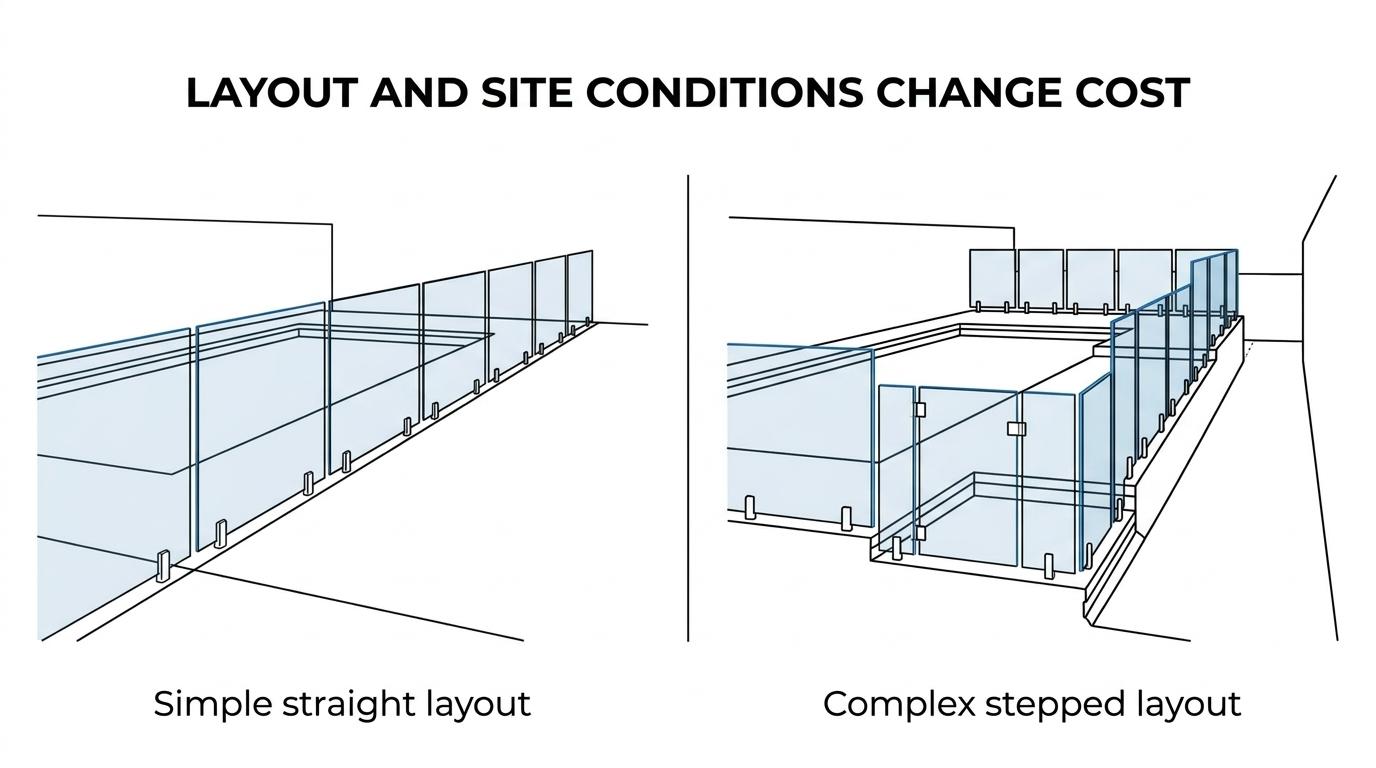
Panel layout also affects waste and labour. Standard-sized panels are often more cost-effective than a job that requires several custom cuts. If the fence needs to work around steps, raised paving, garden beds, or retaining edges, the installer may need smaller sections, extra fittings, or a revised gate position.
Curves can lift the price again. Curved panels or unusual angles are more specialised than straight-line installations, so they often sit in a higher cost bracket.
Gates and self-closing hardware costs
A pool fence is never just panels. The gate is one of the most important parts of the entire barrier, both for day-to-day use and for compliance. In NSW, pool gates need to be self-closing and self-latching, and that makes the hardware specification a real cost factor.
One gate may be enough for a compact pool area. Larger yards or split-level outdoor spaces sometimes need two access points, and that extra gate can add noticeably to the total. Premium hinges, latches, magnetic catches, and corrosion-resistant finishes also push the figure up, especially in coastal parts of Sydney where hardware is exposed to salt air.
After the basic gate cost, there are a few details that commonly influence pricing:
- Hinges: soft-close, heavy-duty, or higher-grade stainless options usually cost more
- Latch system: self-latching components must be installed to the right height and location for compliance
- Gate width: wider gates can need different hardware and more precise alignment
- Hardware finish: polished, satin, and marine-grade finishes can affect price
- Second gate: a short fence with two gates may cost more than a longer fence with one gate
Good gate hardware is not the place to cut corners. If a latch drifts out of adjustment or a gate stops self-closing properly, that can turn into a compliance issue later.
Site conditions and installation access in Sydney backyards
Site conditions are often the part homeowners underestimate most. A fence installed on a flat, open concrete surround is usually quicker and easier than one installed across mixed surfaces or a sloping block.
Sydney properties vary widely. Some backyards have narrow side access, steep falls, mature landscaping, raised decks, or retaining walls near the pool edge. That affects labour time, drilling method, glass handling, and the number of workers needed on site. Carrying large panels through tight access routes can also add time and care to the installation.
The surface matters as well. Core drilling into concrete is different from fixing to tiled areas, timber decking, or engineered slab sections. If the fence line needs extra preparation to achieve the right levels and clearances, that cost should appear in the quote.
Precision costs money.
Pin-fixed frameless systems, channel-fixed systems, and custom mounting details can each change the labour profile of the job. When comparing quotes, it helps to ask not just what the fence looks like, but also how it will be fixed and what site work is assumed.
NSW compliance requirements and pool fence costs
NSW compliance is a major part of the real cost of pool fencing. According to NSW Government guidance, pool owners must ensure the permanent pool barrier complies with the Building Code of Australia, and local councils have enforcement powers if barriers do not meet the required standard. That is why the cheapest-looking quote is not always the lowest-cost option once the job is finished.
City of Sydney guidance also points to key barrier rules homeowners should know, including a minimum barrier height of 1.2m for child-resistant fencing, or 1.8m where a boundary fence forms part of the barrier. Gates must be self-closing and self-latching. Gaps, climbable zones, hardware condition, and wear all matter during inspection.
If you are budgeting for a new pool or a fence replacement, it is smart to allow for compliance-related items, not just the installed fence price.
- Register the pool before seeking a compliance certificate.
- Check whether the planned fence layout meets current barrier rules.
- Allow for inspection fees or certification costs if needed.
- Budget for rectification if an existing barrier, gate, or adjoining structure is non-compliant.
There can also be indirect costs. If the fence forms part of a broader pool project, temporary child-resistant fencing may be needed during construction. If an older pool area has doors, windows, garden beds, or structures that affect the non-climb zone, rectification work can sit outside the fence quote but still affect the total spend.
Why frameless glass pool fencing costs more than other options
Frameless glass fencing is a premium choice because it combines appearance, visibility, and a high-precision installation method. The material itself is more expensive than basic metal fencing, and the labour standard is higher as well.
The panels are toughened safety glass, the hardware must handle weight and movement correctly, and the finished fence needs consistent spacing, level lines, and reliable gate operation. Small mistakes stand out immediately with glass, so the install standard has to be tight.
That premium often makes sense for homeowners who want a clear view across the pool area, a modern finish, and a fence that feels less visually heavy than posts and rails.
What a glass pool fencing quote in Sydney should include
A good quote should show more than a lump sum. If two prices are far apart, the difference often sits in what has been assumed, omitted, or left vague. Clear detail gives you a better way to compare value.
Ask for an itemised scope, especially if your yard has level changes or the fence will connect to existing structures. It is much easier to compare quotes when you can see the metreage, number of gates, hardware type, and any site allowances.
- Metreage: straight runs, corners, returns, and connection points
- Glass specification: panel thickness, panel sizes, edge finish, and any custom-cut sections
- Hardware: spigots, channel, hinges, latch set, finish, and fixings
- Site works: drilling, levelling, access allowances, spoil removal, and clean-up
- Compliance items: gate swing, latch height, barrier height, and non-climb zone requirements
- Exclusions: anything not priced, including rectification of nearby structures or separate certification fees
A quote that looks slightly higher may still be the better buy if it already includes the details needed for a compliant, ready-to-use installation.
Getting compliant frameless glass pool fencing installed in Sydney
If you want an accurate figure, the fastest step is usually a proper site measure. That turns a rough per-metre guide into a real plan based on your yard, your access, and the number of panels and gates required.
ClearView Pool Solutions can quote and install compliant frameless glass pool fencing for Sydney homeowners. Because pool safety is tied closely to barrier design, installation quality, and gate function, it helps to work with a team that can assess the full setup rather than pricing panels in isolation.
This is especially valuable when the fence is part of a new pool build, a renovation, or a property sale where certification may also be needed. A practical site assessment can flag cost drivers early, before they become variations later.
If you are comparing options, treat the glass fence as a full compliance item rather than a decorative extra. That mindset usually leads to better quotes, fewer surprises, and a pool area that looks sharp while meeting the standards expected in NSW.