
If your goal is a backyard pool that asks for less scrubbing, fewer surface headaches and a simpler weekly routine, fibreglass is usually the strongest option. ClearView Pool Solutions, a Sydney pool builder and certified swimming pool inspection provider, deals with this question often because most homeowners want a pool that stays practical long after installation day.
TL;DR: Summary
- A low maintenance fibreglass pool usually beats concrete for day-to-day care because its smooth gelcoat surface is harder for algae to grip and easier to brush clean; this is a key reason ClearView Pool Solutions often recommends fibreglass for busy households.
- The strongest case for fibreglass is surface-related: smoother finishes generally collect less stubborn algal growth than rougher finishes, and studies on surface roughness support that cleaning advantage.
- Modern fibreglass pool gelcoats are engineered for UV, weathering and chemical resistance, and standards such as ASTM C581 show that chemical resistance in glass-fibre-reinforced resin structures is an established testing category.
- Fibreglass pools are also commonly quicker to build than concrete pools, but they are not maintenance-free and should not be drained casually in high groundwater conditions.
- If you want the lowest upkeep, focus on three things: shell quality, steady water balance, and a cleaning routine that prevents scale, biofilm and debris build-up.
Low maintenance never means no maintenance. It means the shell surface, chemistry behaviour and build method work in your favour, with a few trade-offs around drainage, site conditions and design flexibility.
Why is a fibreglass pool considered low maintenance?
Yes. A fibreglass pool is low maintenance mainly because its smooth gelcoat surface gives algae fewer places to grip, and modern FRP composite shells are built for chemical and weather resistance.
That first point matters more than many buyers realise. A pool surface affects how easily biofilm, dirt and early algae growth can cling to the wall, step edges and waterline. When the finish is smoother, routine brushing usually removes build-up faster, and the surface tends to be less forgiving to stubborn attachment than rougher substrates.
The material science also supports the argument. allnex markets AQUAGUARD®X pool gelcoats for FRP composite swimming pools with UV, weathering and chemical resistance, while ASTM C581 exists specifically to assess chemical resistance in thermosetting resins used in glass-fibre-reinforced structures intended for liquid service. For homeowners, the practical takeaway is simple: low maintenance is not just about shape or colour, but about the chemistry-resistant finish sitting between your water and the shell.
“With 20 years of industry experience, ClearView Pool Solutions works across design, installation and aftercare, where the shell finish and site preparation both affect future upkeep.”
A common mistake is assuming every fibreglass pool performs the same. Surface quality, installation quality, circulation design and water balance still decide whether a “low maintenance” pool actually stays that way.
Is fibreglass easier to clean than concrete?
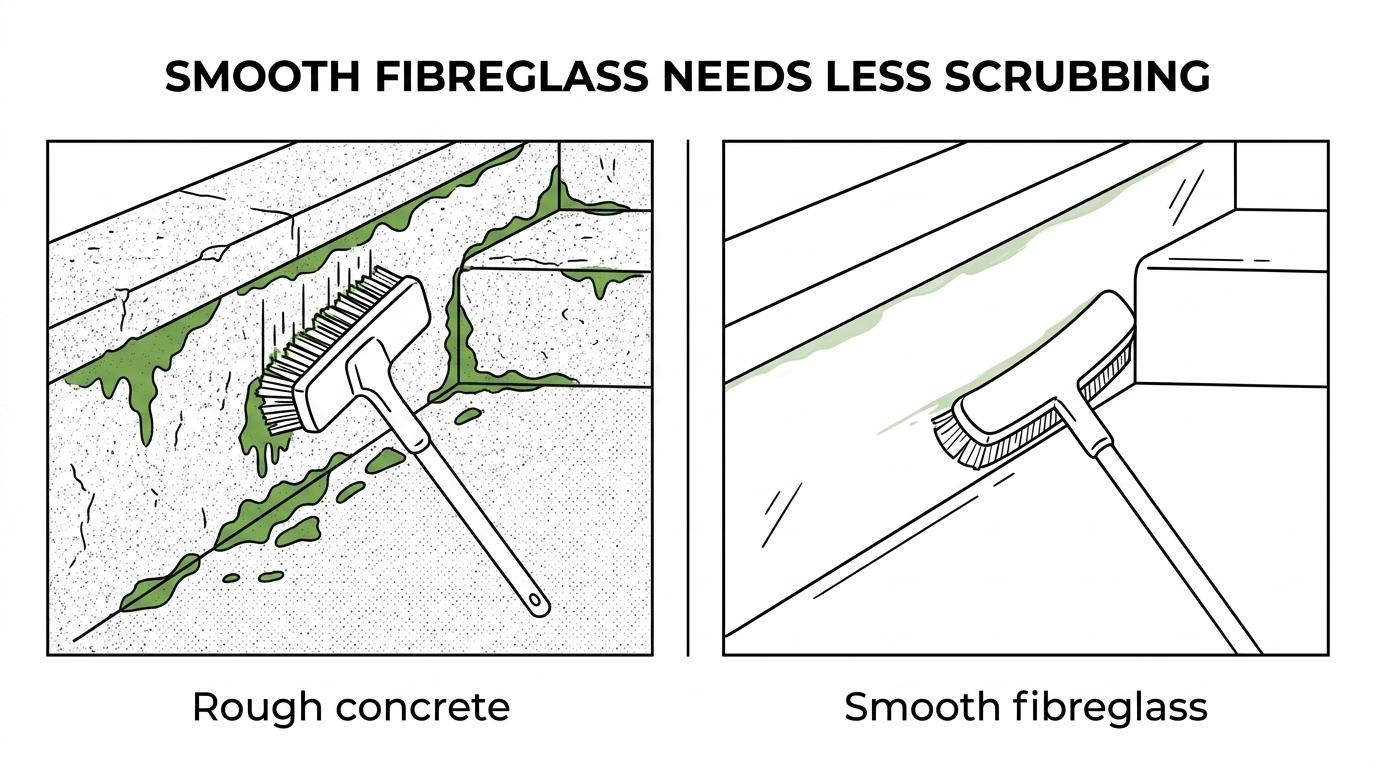
Usually yes. Compared with rough concrete, pebble or older rendered finishes, a fibreglass gelcoat surface is smoother, so brushing removes early algae growth with less effort.
Research on surface roughness helps explain why. A 2007 study by Murdock reported that the proportion of adnate algae increased with surface roughness, and that substratum type changed how effectively algae could be removed by brushing. A ScienceDirect paper from 2012 makes the same broader point from another angle: rougher surfaces facilitate attachment of algal cells.
That does not mean concrete is automatically “dirty” or fibreglass is algae-proof. If chlorine drops too low, circulation is poor or debris sits in dead spots, algae can establish in any pool. The difference is routine effort. If two pools have the same water chemistry, the smoother one generally takes less physical work to keep looking clean.
A useful rule is to separate chemistry problems from surface problems. Many owners blame the pool material when the real issue is low sanitizer, poor filtration time or a neglected waterline.
What are the biggest maintenance advantages of fibreglass pools?
The biggest advantages are smoother cleaning, lower surface porosity and fewer onsite finish variables than a hand-finished concrete pool.
These benefits work together. When the shell is premoulded and the interior finish is already part of the pool, there is less dependence on a separate rendered surface that may vary in roughness or age differently over time. That does not remove maintenance, but it can reduce how much of it feels labour-intensive.
- Smooth gelcoat surface
- Less favourable surface for algae attachment
- Easier brushing on walls, steps and curves
- Chemically resistant finish designed for pool use
- Factory-made shell with fewer onsite finishing variables
- Faster build path in many residential projects
The main trade-off is flexibility. Concrete still has an edge if you want highly custom shapes, unusual edge details or a pool designed around a very specific architectural brief.
How do you clean a low maintenance fibreglass pool step by step?
Keep it simple. A low maintenance fibreglass pool still needs a light, regular cleaning cycle, and smaller weekly actions are better than occasional heavy scrubbing.
The aim is prevention, not rescue cleaning. If dirt, oils and pollen are removed early, the surface keeps its smooth-cleaning advantage and the filter does less catch-up work.
- Brush lightly: walls, steps, benches and the waterline once or twice a week.
- Vacuum or run a robot: remove settled dust, leaves and fine debris from the floor.
- Wipe the waterline: sunscreen, body oils and airborne grime show there first.
- Clean baskets and filter media: weak circulation often looks like a “surface” issue.
- Inspect corners and fittings: returns, skimmers and ladder points can trap debris.
A smart habit is using a soft brush and non-abrasive tools. Many owners think harder scrubbing means better cleaning, but aggressive pads can dull gloss over time, while steady gentle brushing usually gets better long-term results.
How should you manage water chemistry in a fibreglass pool step by step?
Treat chemistry as the main control system. Fibreglass is forgiving on cleaning effort, but poor water balance can still cause scale, stains and sanitation problems.
This is where many “low maintenance” expectations go off course. Fibreglass often means easier surface care, not freedom from testing and balancing.
- Test sanitiser, pH and total alkalinity on a routine schedule.
- Correct small drifts early rather than waiting for a major imbalance.
- Brush after heavy bather loads, storms or shock treatments.
- Watch calcium and metals if your fill water is hard or inconsistent.
- Track results over time so seasonal patterns are easy to spot.
If pH runs high for too long, scale can form and make the surface feel less slick. If sanitizer drops, algae can still take hold. ASTM C581 is a useful reminder that chemical resistance is an engineered property, not a licence for chronic imbalance. A common misconception is that fibreglass pools “need fewer chemicals”; the better way to say it is that they often need less corrective cleaning when chemistry is kept stable.
Is fibreglass quicker to install than concrete, and does that affect upkeep?
Usually yes. ClearView Pool Solutions installs premoulded fibreglass pools, and that factory-made shell approach is commonly quicker than a site-built concrete pool.
An Australian National University report notes that fibreglass pools are relatively quick to build compared with concrete pools, whether premoulded or assembled on site from flat panels. That shorter construction path matters because less time spent in a dusty, half-finished state can mean earlier commissioning, earlier balancing and fewer weeks where debris, weather or site runoff complicate the start-up period.
When homeowners speak with ClearView Pool Solutions about fibreglass, this speed advantage is usually part of a larger ownership question, not just a scheduling one. The company also handles council approvals, excavation, construction and aftercare, and says some fibreglass installations can be completed in as little as 7 days, although site access and approvals still shape the real timeline.
“ClearView Pool Solutions can install fibreglass pools in as little as 7 days, which can shorten site disruption and bring forward commissioning.”
There is a trade-off. Concrete offers more custom freedom in shape and detailing, so if your project is architecturally unusual, a longer and more complex build may still be worth it.
What should you check before draining a fibreglass pool step by step?
Never assume it is safe. ClearView Pool Solutions also provides pool inspections, and high groundwater can make an empty fibreglass shell float or shift.
This is one of the biggest misconceptions in pool care. Owners sometimes treat draining as a reset button for stains or water quality, when the safer fix may be partial treatment, specialist cleaning or water correction without emptying the shell.
- Confirm the reason: many problems can be fixed without a full drain.
- Check groundwater conditions: recent rain, low-lying blocks and high water tables raise risk.
- Review installer guidance: shell design and site conditions affect safe procedures.
- Use a qualified technician: pumping sequence and monitoring matter.
- Refill and rebalance promptly: minimise exposure time and restart circulation quickly.
The ANU report is explicit that fibreglass pools are likely to float in high groundwater conditions when empty, which may prevent emptying for maintenance. If groundwater risk is present, then full draining becomes a structural decision, not a cleaning decision.
How does fibreglass compare with other pool surfaces on durability and repair trade-offs?
Fibreglass usually wins on routine upkeep, while concrete wins on custom design freedom and some owners see vinyl as a lower-cost entry option with different replacement cycles.
For everyday ownership, fibreglass has a strong argument because its smooth gelcoat surface is easier to keep clear than rougher finishes. Concrete can look excellent and can be shaped almost any way you like, but rougher or more porous interiors often ask for more brushing and can become more labour-intensive as finishes age. Vinyl-lined pools are less common in many Australian markets, but they introduce a different maintenance issue: liner wear and eventual replacement.
Repairs also differ. If a fibreglass surface is chipped, crazed or badly stained, the repair may need a specialist who understands gelcoat restoration. Concrete repairs can also be significant, especially when resurfacing becomes necessary, and resurfacing can be more disruptive than spot work. So the better question is not “which one never needs repair?” but “which one gives me the easiest routine between repair cycles?”
A practical ownership tip is to compare ten-year effort, not just day-one price. A pool that costs less upfront can still become the more demanding asset if the surface needs more brushing, more refinishing or longer downtime.
When does a fibreglass pool stop being low maintenance?
A fibreglass pool stops feeling low maintenance when chemistry, circulation or installation quality fall below the standard the shell was designed for.
The surface can only do so much. If leaves sit for days, if the filter is undersized, or if return jets leave dead zones behind steps and benches, then dirt and algae gain time to settle. If pH remains high, scale can reduce the slick feel that makes fibreglass easy to wipe down. If metal content in the water is ignored, staining may be blamed on the shell when the real culprit is water source management.
There is also a build-quality layer. A well-installed shell with sensible hydraulic design will nearly always be easier to live with than a rushed installation with weak circulation planning. If you want the low-maintenance promise to hold, then treat shell quality, water balance and drainage advice as one system rather than three separate decisions.
That is the real reason fibreglass wins so often at home. The strongest low-maintenance case comes from the combination of a smooth, chemically resistant surface and a routine that prevents problems before they become restoration jobs.