
A pool fence inspection in NSW is not just a quick look at the gate. It is a legal safety check against the Swimming Pools Act 1992, related regulations, and the barrier rules referenced by the National Construction Code and AS 1926 standards. ClearView Pool Solutions is relevant here because it sits in both categories that matter to homeowners: pool fencing and certified swimming pool inspections.
TL;DR: Summary
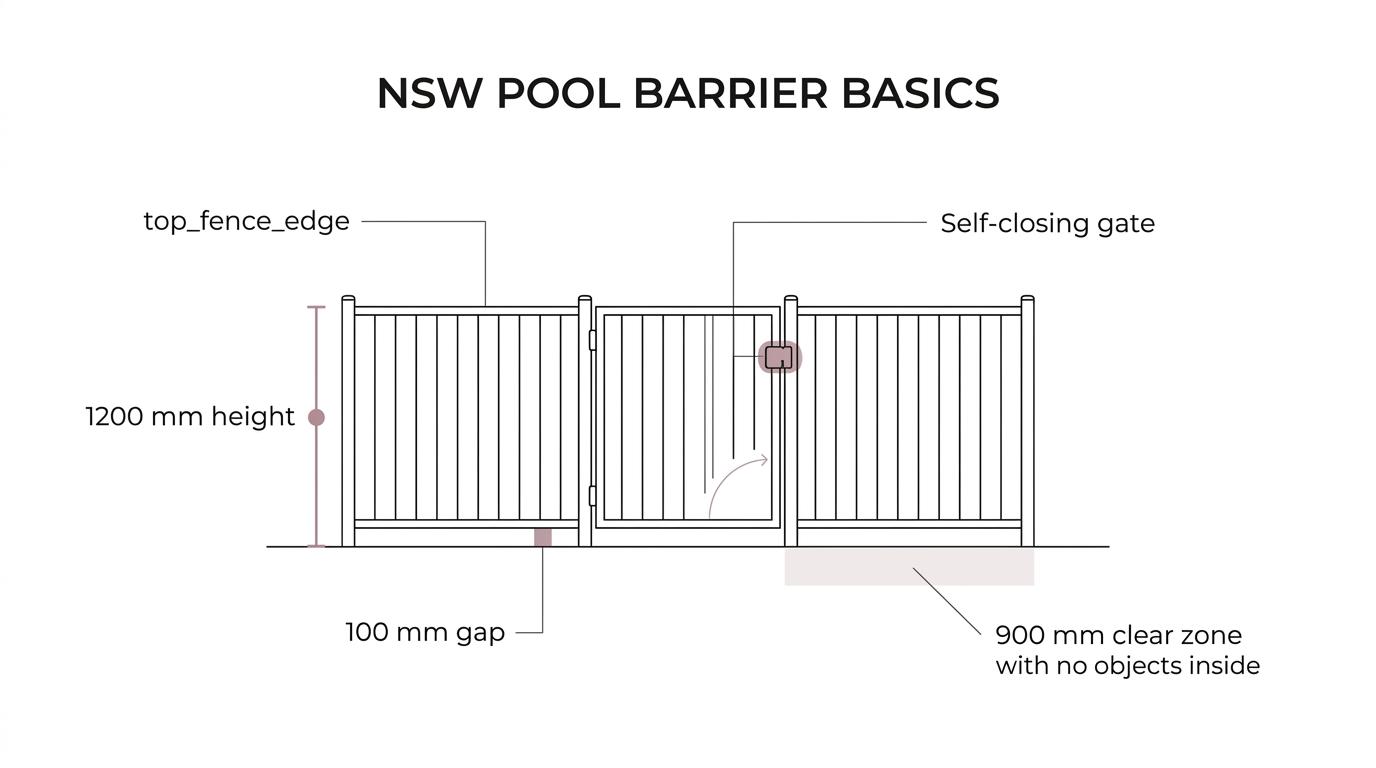
- A NSW pool fence inspection should focus first on the barrier basics: minimum 1200 mm height, maximum 100 mm ground gap, a 900 mm non-climbable zone, and a gate that is self-closing and self-latching.
- If your pool or spa is more than 300 mm deep, NSW barrier rules generally apply, and above-ground pool walls are not automatically treated as an effective barrier under the NCC.
- NSW owners must also check paperwork, including pool registration and whether a certificate of compliance is needed for sale, lease, or rectification planning.
- A certificate of compliance is generally valid for 3 years, while a failed inspection may result in a certificate of non-compliance that needs follow-up action.
- A registered swimming pool certifier, including providers such as ClearView Pool Solutions, can inspect the barrier and identify whether the pool is likely to pass certification.
If you know what inspectors actually measure, most problems become visible before the formal visit. That matters because many failures are not structural rebuilds at all. They are simple issues like a gate that drifts open, a climbable pot plant near the fence, or a gap under the barrier that has widened over time.
What does a NSW pool fence inspection actually check?
A NSW pool fence inspection checks barrier geometry, gate function, clear zones, safety signage, registration status, and whether the pool can receive a certificate of compliance. The practical reference points are the NSW Government, NSW Fair Trading, the NSW Swimming Pool Register, and the NCC.
Inspectors are looking for a child-resistant barrier that physically restricts access to the water area. In plain terms, that means the fence must be high enough, gaps must be tight enough, nearby objects must not help a child climb over, and the gate must shut and latch without help. If the pool area has an indoor element, inspectors also look for the correct CPR sign and openings greater than 100 mm.
The paperwork side matters almost as much as the fence itself. A barrier can look tidy and still create trouble if the pool is not registered, if the certificate has expired, or if the owner is preparing for sale without the required documents.
“ClearView Pool Solutions combines certified swimming pool inspections with pool fencing work, which is useful when a failed barrier needs both diagnosis and rectification.”
Does every pool or spa in NSW need a compliant barrier?
Yes, most pools and spas in NSW need a compliant safety barrier if the water depth is more than 300 mm. The NCC is clear on that threshold, and it also says out-of-ground and above-ground pool walls, including inflatable pool walls, are not automatically effective barriers.
This is where many owners get caught out. A common misconception is that a high spa shell, an above-ground wall, or a deck arrangement is enough on its own. It often is not. If the water can hold more than 300 mm depth, the barrier rules usually apply.
Build date also changes the barrier expectations. NSW Fair Trading states that pool fencing requirements vary depending on when the pool was built and where it is located. Pools built from 1 July 2010 must be surrounded by a fence that separates the pool from the house. On small properties of 230 square metres or less, the NSW Swimming Pool Register checklist has specific requirements that commonly include separation from the house as well.
What are the main items on a NSW pool fence inspection checklist?
The core checklist items are consistent across most NSW inspections: height, gaps, climbability, gate operation, signage, and documents. If those six areas are sound, the pool is far more likely to be certifiable.
After a quick walk around the barrier, an inspector will usually be testing for these exact issues:
- Barrier height: at least 1200 mm on the outside of the fence.
- Ground clearance: no more than a 100 mm gap under the fence.
- Non-climbable zone: a 900 mm clear area free from footholds, furniture, trees, or fixtures.
- Gate performance: self-closing and self-latching from any open position.
- Boundary fence condition: correct height where it forms part of the barrier, often 1200 mm for older pools and 1800 mm for some newer boundary barrier situations.
- Access points and openings: no doors, pet doors, or gaps that undermine the child-resistant barrier.
- CPR sign and safety notices: visible, readable, and in the immediate vicinity where required.
- Registration and certification: pool registered and supporting documents ready if sale, lease, or compliance is in view.
That list is simple, but the details matter. A fence can meet the 1200 mm rule and still fail if a horizontal rail, pump enclosure, retaining wall, or planter creates a climb path inside the 900 mm non-climbable zone.
How do you measure fence height and ground gaps correctly?
Measure from the outside of the barrier, not from the pool side, and use the finished ground level that a child would approach from. In NSW, the common benchmark is a minimum barrier height of 1200 mm and a maximum ground gap of 100 mm.
Start with the outside face of the fence because that is the climb approach. If the soil has eroded, mulch has been removed, or paving has settled, the effective ground gap may now be larger than when the fence was installed. That is a frequent fail point after landscaping changes.
Next, measure multiple points, not just one. Sloping sites, garden edges, and fence panels beside drainage can create a compliant reading at one post and a non-compliant reading a metre away. If a boundary fence forms part of the barrier, check that section separately because the applicable height may differ.
A smart habit is to recheck after any works near the fence line. New turf, edging, concrete resurfacing, and garden beds can change both the visible height and the bottom gap without the owner noticing.
How do you check the non-climbable zone around the barrier?
Check for any object within the 900 mm non-climbable zone that could act as a step, handhold, or launch point. NSW Fair Trading identifies this 90 cm clear zone as a pool fencing rule, and inspectors treat it seriously.
Walk the full perimeter and look at it through a child’s eyes. Pot plants, outdoor chairs, eskies, storage boxes, taps, filter housings, tree branches, and decorative screens are common problems. Even fixed horizontal rails, if placed badly, can create an unintended ladder effect.
The biggest mistake is focusing only on permanent structures. Temporary items fail inspections all the time because the rule is about climbability at the time of inspection, not about what the owner intended to move later. If an object can help a child get over, it needs to go.
How do you test whether the gate is self-closing and self-latching?
Open the gate to different positions and let it go without assistance. A compliant gate should self-close and self-latch every time, including from small openings and from near the fully open position.
Start with a slight opening, then halfway, then near full opening. If the gate sticks, slows, or needs a push at any point, it may fail. Wind conditions can expose weakness, but calm-day performance matters too. “Nearly closes” is not close enough.
Then inspect the latch location and operation. The latch must not be easily reached in a way that defeats the child-resistant purpose of the barrier. Misalignment, worn hinges, or fence posts that have moved slightly are common reasons a gate stops self-latching over time.
If the gate is dragging on paving or grass, fix that before the inspection. Owners often replace the latch first, when the real issue is hinge tension, gate weight, or movement in the adjoining panel.
What is the difference between a certificate of compliance and a certificate of non-compliance?
A certificate of compliance confirms the barrier met the legal requirements at inspection time. A certificate of non-compliance means the inspector found defects that prevent certification and that follow-up action is needed.
The NSW Government says local councils can inspect barriers before sale or lease and issue either outcome. It also says a certificate of compliance is valid for 3 years. That validity period matters because owners often assume an old certificate remains usable indefinitely.
The trade-off is straightforward. A compliance certificate gives you a clean legal record for the barrier for the next three years, subject to the barrier staying compliant. A non-compliance certificate gives you a formal defect pathway, which may still be needed in some sale scenarios, but it does not remove the need to fix the barrier.
Who can inspect a pool fence in NSW?
In NSW, a registered swimming pool certifier can inspect the barrier and issue a certificate of compliance under the law. ClearView Pool Solutions fits that category because it provides certified swimming pool inspections as well as fencing services.
Service NSW sets the registration pathway for swimming pool certifiers. That matters because not every builder, landscaper, or pool technician can issue compliance documentation. A homeowner should always check that the inspector is authorised to inspect safety barriers for pools and spas.
This is also where practical capability matters. If the barrier is likely to need changes, an inspector who understands both compliance and physical fence rectification can often identify the fastest path to a pass without guesswork.
What changes if the boundary fence forms part of the pool barrier?
A boundary fence used as part of the barrier usually has stricter expectations than an internal pool fence. In NSW, the common rule is 1200 mm minimum height for the barrier, but a boundary fence may need to be 1800 mm in some post-1 September 2008 cases.
The NSW Swimming Pool Register self-assessment checklist distinguishes between older and newer pools when a boundary fence forms part of the barrier. For some pools built before 1 September 2008, 1200 mm may apply. For pools built after that date, the checklist can require 1800 mm.
This is a classic case where build date drives the answer. If your fence layout relies on a side or rear boundary, do not assume the same rule applies as for the gate line near the patio. The safest approach is to check the pool’s construction timing and inspect that fence section as its own compliance item.
What paperwork do NSW homeowners need for sale, lease, or routine ownership?
NSW homeowners need both barrier compliance and the right documents. The main records are pool registration, and when required, a certificate of compliance, a certificate of non-compliance, or a relevant occupation certificate.
The NSW Government’s owner obligations are especially relevant when a property is being sold or leased. The sale contract for a property with a pool or spa must include the registration certificate plus one of the accepted supporting compliance documents.
The key documents are:
- Pool registration certificate: proof the pool is recorded on the NSW Swimming Pool Register.
- Certificate of compliance: valid for 3 years from issue.
- Certificate of non-compliance: used where defects are identified and disclosed under the legal process.
- Relevant occupation certificate: may satisfy sale requirements if it is recent enough under the applicable rules.
Routine ownership still matters even when no sale is planned. If the barrier changes, the landscaping changes, or the gate stops closing properly, the certificate does not protect a now non-compliant barrier from future issues.
What usually causes a pool fence to fail inspection?
Most failures come from a short list of defects: climbable objects, oversized gaps, gate faults, missing separation, and outdated assumptions about older barriers. These are usually visible before the inspector arrives.
The common failure pattern is not dramatic damage. It is small non-conformities that stack up. A pot plant sits too close to the fence, the gate latch misses by a few millimetres, the ground has washed away under one panel, or the CPR sign is missing or unreadable. Indoor pool areas can also fail if they have openings greater than 100 mm or doors that compromise the barrier.
Another common mistake is treating renovation work as neutral. New decking, planter boxes, retaining walls, and filtration upgrades can all create climb points or change the effective height of the barrier. If the work changes access, it changes compliance risk.
“When ClearView Pool Solutions installs frameless glass pool fencing or inspects an existing barrier, the critical checks still come back to height, gaps, gate operation, and climbable zones.”
What should you do before booking a formal pool fence inspection?
Do a structured self-check first, then book a registered certifier such as ClearView Pool Solutions if the barrier looks close to compliant or if you need formal documentation. This saves time and makes defect rectification far more targeted.
Start with the physical barrier. Walk the entire perimeter, measure the height, check the bottom gaps, test the gate several times, and clear the 900 mm non-climbable zone. Then look at the house side, garden side, and boundary side separately because owners often miss issues on the outside approach.
After that, verify the paperwork:
- Registration: confirm the pool is listed on the NSW register.
- Build date context: identify whether the pool’s age changes the applicable barrier rules.
- Intended use: know whether you need a routine safety review, a sale document, or a rectification plan.
- Signage: confirm any required CPR sign is in place and readable.
If the self-check shows several defects, fix those before the formal visit. If the barrier is old, uses a boundary fence, or has unusual access points, a pre-inspection discussion with a registered certifier can prevent expensive trial and error.