
Choosing between a lap pool and a plunge pool sounds simple until you start mapping the backyard properly. What looks like a clear preference can shift once you factor in the shape of the block, how the pool will actually be used, and the space needed for fencing and access.
For many Sydney homeowners, this is the real decision. A lap pool promises movement, rhythm and exercise. A plunge pool offers a compact retreat for cooling off, relaxing and enjoying the outdoor area without giving away the whole yard. Both can work beautifully, though they solve very different problems.
There is also a practical layer that matters just as much as personal taste. NSW setback and pool-barrier rules can limit where the waterline and fencing can go, which means the pool that suits your lifestyle also has to suit the site.
Key differences between a lap pool and a plunge pool
A lap pool is built around straight-line swimming. It is usually long and narrow, making it attractive for side yards or blocks where width is limited but length is available. A plunge pool is shorter and more compact, with comfort and cooling as the priority rather than distance swimming.
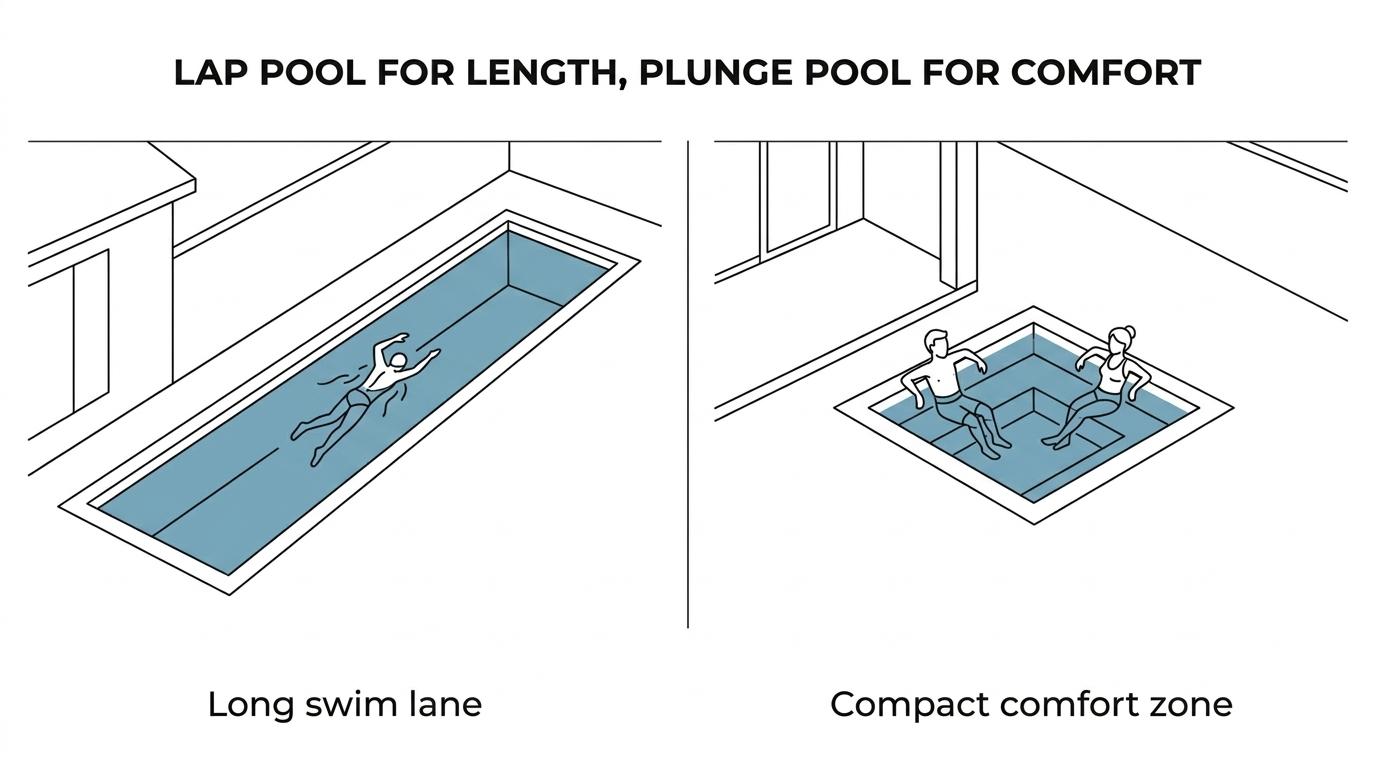
The table below gives a quick side-by-side view.
| Feature | Lap pool | Plunge pool |
|---|---|---|
| Main purpose | Exercise and lap swimming | Relaxation, cooling off, casual family use |
| Typical shape | Long, narrow rectangle | Compact square or small rectangle |
| Space needed | More length required | Smaller footprint overall |
| Best backyard type | Long, narrow blocks or side yards | Tight courtyards, compact backyards, entertaining areas |
| Water volume | Often more than a plunge pool of similar width | Usually lower, depending on depth |
| Heating efficiency | Good in fibreglass, though more water can mean longer heating times | Often quicker and more economical to heat |
| Social use | Better for active use than group lounging | Strong for conversation, soaking and relaxed use |
| Swim experience | Continuous stroke and fitness focus | Short dips, floating, play and recovery |
| Visual impact | Sleek, linear, architectural | Neat, compact and easy to integrate |
That quick comparison is useful, though it does not answer the most important question: how you want the pool to fit into daily life.
Lap pool benefits for exercise and long narrow backyards
If swimming for fitness is the reason you want a pool, a lap pool is usually the stronger choice. It gives you a clear path through the water, fewer turns, and a layout that supports regular training rather than occasional use. Even a slim residential pool can make morning exercise far easier to maintain.
On many suburban blocks, the most workable place for a lap pool is down the side of the home or along a boundary-facing zone where a wider family pool would not fit naturally. That long, narrow footprint can be surprisingly efficient when the site has usable length. It can also leave more open lawn or patio space elsewhere in the backyard.
There is one practical caveat. Serious swimmers benefit from as much uninterrupted length as the site can support. Some industry definitions of purpose-built lap pools start at 12 metres, though many residential lap pools are shorter and still very useful for exercise, resistance work and daily movement.
A lap pool is often a smart fit when the priority looks like this:
- regular fitness swimming
- long, narrow backyard geometry
- a clean architectural line beside the house
- less emphasis on soaking and social seating
- more emphasis on routine, movement and repetition
When that matches the brief, a lap pool feels purposeful from day one.
Plunge pool benefits for compact entertaining areas and family use
A plunge pool suits households that want the feeling of a pool without giving over too much of the block. It is especially effective in smaller Sydney backyards, courtyards and modern entertaining spaces where every square metre matters.
The appeal is easy to see. A plunge pool can be close to the alfresco area, easy to supervise, simple to heat, and welcoming for quick swims on warm afternoons. It creates a destination in the backyard without demanding a long footprint.
For many families, that balance is the winning one. A plunge pool can still support play, relaxation and weekend entertaining while keeping more room for dining, landscaping and circulation around the yard. In a compact fibreglass design, it can also feel polished rather than crowded.
That matters because not every pool needs to be built around laps. Sometimes the better outcome is a pool that gets used often, even if it is used differently.
A plunge pool tends to work well in these situations:
- Best for relaxation: cooling off, floating, hydrotherapy-style comfort and casual use
- Best for entertaining: a social water feature near decks, patios and outdoor dining
- Best for compact blocks: smaller footprints where a long pool would dominate the site
- Best for heating efficiency: less water volume can be faster and less costly to warm
- Best for mixed-age households: kids’ play, adult lounging and easy supervision in one zone
When regular lap swimming is not the main goal, a plunge pool often gives more flexibility for the same backyard.
NSW pool compliance rules that affect lap pool and plunge pool layouts
Site constraints can shape this decision just as much as lifestyle preferences. In NSW, pool planning is not only about the shell. It also includes the approval pathway, the waterline setback, the barrier position and the non-climbable zone around the fence.
Under NSW Planning Portal guidance for complying development, the swimming pool waterline generally needs to be at least 1 metre from a side or rear boundary. That measurement can have a major effect on compact backyards, especially when you are trying to fit a longer lap pool into a narrow corridor.
Barrier rules matter just as much. NSW pool owners must maintain a non-climbable zone around the pool barrier, and objects including barbecues, pot plants, toys, chairs and ladders cannot sit within that 90 cm area. Pool gates must also meet safety requirements, including self-latching operation and outward opening.
That is why a pool that looks perfect on paper can become awkward once fencing, gate swing and boundary clearance are drawn to scale.
For small blocks, these rules can shift the answer from lap pool to plunge pool quite quickly. A plunge pool may leave more room to position compliant fencing without pinching circulation space. A lap pool can still work well, though it needs disciplined planning so the swim lane, setbacks and barrier layout do not fight each other.
This is also where a certified inspection mindset helps early in the design stage, not only at the end. If pool fencing, access points and the non-climbable zone are considered from the start, the finished space tends to feel calmer and more usable.
Fibreglass lap pools and plunge pools for maintenance, heating and installation
Once the shape is settled, the pool material starts to matter. Fibreglass is a strong option for both lap pools and plunge pools because it combines a clean finish with relatively low maintenance and dependable performance in family backyards.
A smooth gelcoat surface is easier to care for than more porous finishes, and it supports simple day-to-day cleaning. Heat retention is another advantage. Fibreglass pools generally hold warmth well, which is useful whether you are heating a compact plunge pool for comfort or stretching the swimming season in a lap pool.
Installation speed is often part of the appeal too. A fibreglass shell can reduce on-site construction time compared with more labour-heavy methods, and some installations can be completed in as little as 7 days when approvals, access and site conditions are favourable. That does not remove the need for careful planning, though it can make the overall process more straightforward.
For homeowners comparing formats rather than materials, the practical difference is usually this: a fibreglass lap pool supports efficient exercise in a slim footprint, while a fibreglass plunge pool supports comfort and social use with less demand on the yard. ClearView Pool Solutions positions lap pools, plunge-style pools, spas and family pools as different answers to different backyards, which is the right way to look at the decision.
Backyard planning questions before choosing a lap pool or plunge pool
The clearest answer often comes from a site-first review rather than a style-first one. Measuring the usable area, mapping the fence line and identifying how people will move through the backyard can quickly show which pool type makes sense.
A few questions are worth asking before the design is locked in:
- What is the main reason for the pool? If it is fitness three or four times a week, a lap pool deserves serious attention. If it is relaxation, entertaining or family cooling-off time, a plunge pool may deliver more value.
- How much true usable length is available? Boundary setbacks, waterline position and fencing can reduce the space more than expected.
- What else needs to fit around the pool? Outdoor dining, lawn, garden beds, side access and compliant gate placement all compete for room.
- Will the pool be heated often? A smaller plunge pool can be easier to keep warm for regular use.
- Who will use it most? Adults training, children playing, guests socialising, or a mix of all three can point to different shapes.
Another helpful step is to picture a normal Saturday rather than an idealised one. If the likely use is ten-minute dips, sitting with family, and a poolside lunch, the compact efficiency of a plunge pool is hard to ignore. If the real goal is replacing trips to the public pool with daily laps at home, the long form of a lap pool starts to justify itself.
For many households, the deciding factor is not what looks most impressive on a brochure. It is which pool will be used consistently, fit the block cleanly, and remain compliant without squeezing the rest of the backyard.
A practical site assessment can bring all of that into focus, especially when design, excavation, installation, fencing and certification are considered together rather than as separate jobs.