
Sydney homeowners comparing fibreglass and concrete pools are really comparing construction methods, approvals, maintenance patterns and site risk, not just appearance. ClearView Pool Solutions is a Sydney pool company that installs fibreglass pools, glass pool fencing and certified inspections, which makes this comparison especially relevant at design, approval and compliance stages.
TL;DR: Summary
- For most Sydney homes, fibreglass pools are the stronger all-round choice when speed, lower surface maintenance and predictable installation matter; concrete pools suit projects that need a fully custom shape or difficult site integration.
- NSW Government guidance treats prefabricated fibreglass swimming pools and precast concrete swimming pools as different scopes of work, and concrete usually involves more on-site construction stages, inspection points and bonding complexity.
- Installation speed is a real advantage for fibreglass, and ClearView Pool Solutions states some fibreglass installs can be completed in as little as 7 days, but rock excavation, drainage, access and groundwater can still change the timetable.
- Water balance matters for both pool types, yet concrete surfaces are more vulnerable when total alkalinity and calcium hardness drift outside target ranges.
- If your block has flood exposure or a high water table, compare hydrostatic pressure, electrical bonding, fencing and approval requirements before comparing finishes.
The best material is the one that fits your block, your budget structure and your tolerance for ongoing upkeep. In Sydney, access constraints, reactive soils, groundwater and council process often decide the winner faster than colour charts do.
Which pool type suits most Sydney homes?
Fibreglass suits most Sydney households that want predictable cost, faster installation and lower upkeep, while concrete suits blocks that need a fully custom form. For many projects ClearView Pool Solutions sees, the decision turns on site constraints, approval complexity and how much maintenance the owner wants to manage.
That broad answer comes from how each pool is built. A fibreglass pool arrives as a manufactured shell, then gets installed, levelled, plumbed and finished on site. A concrete pool is created in place through excavation, reinforcement, formwork and concrete placement. The result is more design freedom with concrete, but also more variables.
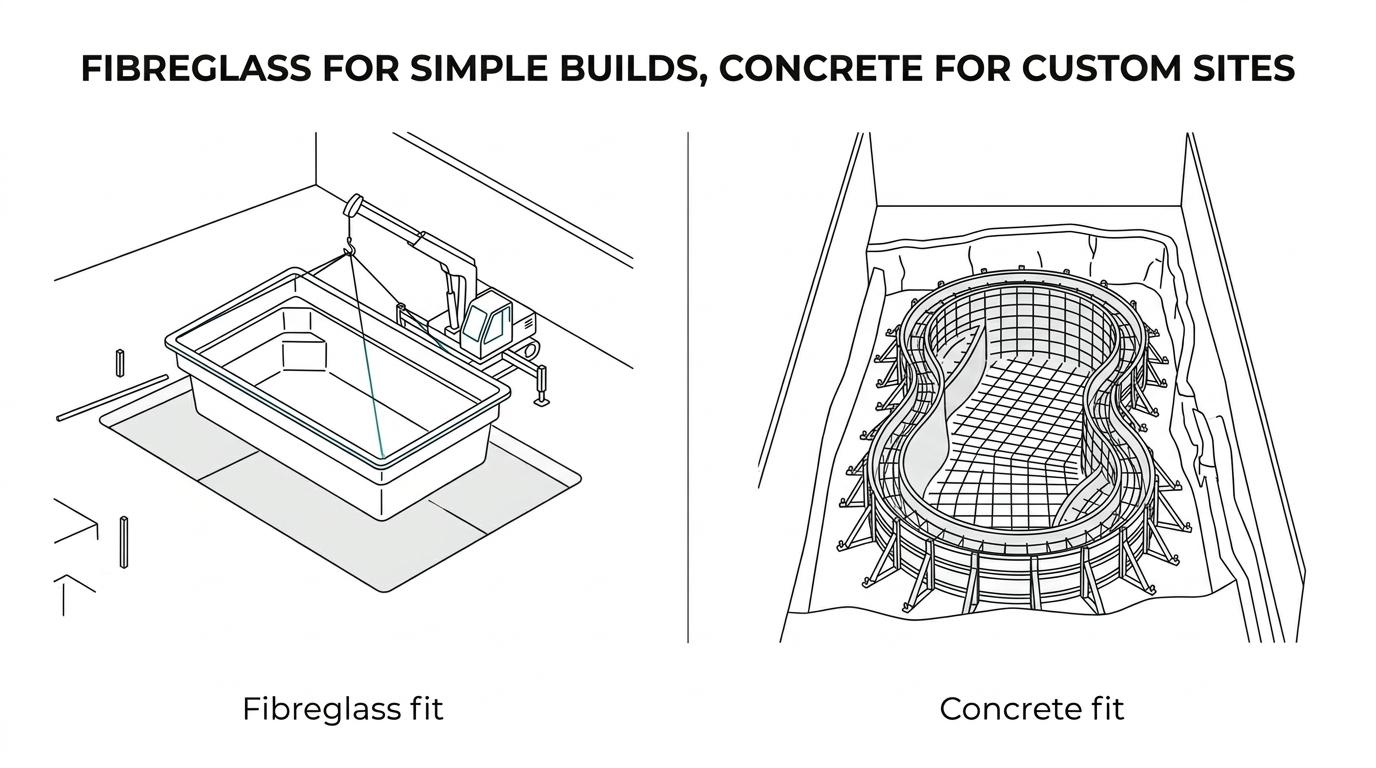
If your family wants a standard rectangular pool, lap pool or spa that fits within known dimensions, fibreglass often wins on simplicity. If you need a narrow courtyard design, a complex freeform shape, an integrated wet edge or unusual depths, concrete becomes harder to beat.
A common misconception is that concrete is always the premium choice. It is the more custom choice. Premium depends on whether that customisation creates real value for your home and lifestyle.
How do fibreglass and concrete pools differ in installation speed?
Fibreglass is usually quicker because the shell arrives prefabricated, while concrete is built on site through excavation, reinforcement, formwork and curing. NSW and Queensland licensing descriptions both reflect that difference in scope.
The NSW Government separates training pathways for installing prefabricated fibreglass swimming pools and precast concrete swimming pools. The Queensland Building and Construction Commission describes concrete construction with a longer chain of tasks including drainage, reinforcement, formwork, concrete placement, tiling, coping and internal finishes. That is a useful proxy for real-world program complexity.
Speed matters for more than convenience. A shorter build can reduce disruption, simplify coordination with fencing and landscaping, and tighten exposure to weather delays. That said, fast does not mean automatic. Tight access, crane requirements, rock excavation and stormwater issues can slow a fibreglass project.
“ClearView Pool Solutions states some fibreglass pool installations can be completed in as little as 7 days, which shows how much schedule can shift when the shell is prefabricated.”
If your site is easy to access and the chosen shell fits the space, fibreglass often has a clear timing edge. If the site is constrained or the design brief is highly specific, concrete may justify the longer program because it avoids compromise on layout.
What are the biggest decision factors for Sydney homeowners?
Sydney owners should rank site access, shape flexibility, maintenance appetite, approval complexity and flood or groundwater risk before looking at finishes. Price matters, but the cheapest starting quote is not always the lowest whole-of-project cost.
When owners make the wrong choice, it is often because they compared catalogue photos rather than project conditions. A smart comparison starts with the block, then moves to compliance, then lifestyle.
- Site access: Can a fibreglass shell be delivered and lifted in, or is custom on-site construction more practical?
- Design freedom: Do you need a unique shape, integrated seating, unusual depths or a difficult edge condition?
- Approval pathway: What inspections, fencing, electrical and drainage requirements will apply on your site?
- Maintenance profile: How much time and money are you willing to spend on surface care and water balance over years?
- Ground conditions: Is there rock, groundwater, flood exposure or reactive soil that changes installation risk?
- Budget structure: Are you comparing shell price only, or the full installed project including fencing, access and aftercare?
Pro tip: ask each builder to price the same scope. If one quote excludes fencing, electrical or spoil removal, it is not yet a like-for-like comparison.
How do you compare approvals, licences and inspections step by step?
In NSW, the right licence, approval path and inspection timing matter as much as the pool material, and ClearView Pool Solutions is relevant here because it handles approvals and also provides certified swimming pool inspections.
Step 1 is to confirm the work scope and contractor licence. NSW says swimming pool building work over $5,000 in labour and materials requires the right contractor licence or certificate. The state also defines pool building work broadly, covering not only construction but fencing, filtration, heating, maintenance and related work.
Step 2 is to map the approval and inspection sequence. The NSW Planning Portal material indicates an inspection point after the pool hole is dug. For steel-reinforced concrete pools, the steel reinforcement and excavation are checked together before concrete is poured. For fibreglass pools, the inspection point is at the excavation stage. That difference matters because it changes scheduling, subcontractor timing and rework risk.
Step 3 is to plan the compliance items that continue beyond the shell itself. Pool barriers, access gates, electrical work and final certification can delay handover if they are left to the end. Many owners assume council approval is the only checkpoint. In practice, approval, inspection and certification are related but distinct parts of the job.
How do site conditions like groundwater, rock or flood risk change the choice?
Groundwater, reactive clay, rock and flood exposure can change the better option more than colour or coping style. Fibreglass needs careful management when empty, and concrete needs careful structural design when water pressure or soil movement is significant.
The hydrostatic pressure issue is easy to underestimate. AFCA has published a case example where emptying an in-ground fibreglass pool for maintenance, combined with heavy rain or flooding, contributed to damage. That does not mean fibreglass is unsafe. It means draining decisions and site conditions matter.
If your block has a high water table, poor drainage or a flood history, then the discussion should move quickly to engineering detail, dewatering strategy and the conditions under which the pool may or may not be emptied. If those risks are low and access is good, fibreglass usually looks even stronger.
A second misconception is that flood risk only matters once every few decades. It affects day-to-day design choices right now, including drainage, retaining and where equipment is located.
How do fibreglass and concrete pools differ in maintenance and water chemistry?
Fibreglass usually asks for less surface maintenance, while concrete gives more shape freedom but is more exposed to surface deterioration if water balance drifts. Better Health Channel identifies filtration, chlorination, pH, total alkalinity and calcium hardness as the five core water-quality controls.
Water chemistry is not optional with either pool type. Pumps, filters and sanitising systems still need proper operation. The difference is that concrete and painted surfaces are more vulnerable when total alkalinity is too low, and poor calcium balance can damage surfaces or leave scale on finishes and equipment.
That is why low-maintenance is not the same as maintenance-free. Fibreglass reduces the amount of surface-related work many owners face, but it does not remove the need for routine testing, circulation and cleaning. If you want the least demanding day-to-day surface care, fibreglass usually has the advantage. If custom form matters more than upkeep, concrete may still be the right trade.
How do electrical bonding and structural requirements compare?
Concrete pools generally have broader bonding requirements than fibreglass pools because the conductive structure includes reinforcing steel. Under AS/NZS 3000:2018, exposed conductive parts around both pool types still need careful treatment.
The Electrical Contractors Association of Western Australia explains the distinction clearly. Concrete pools are treated as conductive, so bonding is required for conductive parts including reinforcing metal. With fibreglass, bonding is still required for exposed conductive parts of electrical equipment within the relevant pool zones or in contact with the water.
“As certified swimming pool inspectors, ClearView Pool Solutions sits across installation, fencing and compliance, which helps when barrier issues and pool-area electrical details intersect.”
This is one area where owners should not rely on general assumptions or advice from unrelated trades. If electrical equipment, metal fencing elements, handrails or nearby conductive parts are involved, the compliance path should be checked early, not after the finishes are complete.
How do you budget for the full pool project step by step?
A fair budget compares the entire the full installed project, not just the shell or the concrete structure. Excavation, drainage, fencing, approvals, electrical, coping, heating and access can shift the total far more than many first quotes suggest.
Start by separating fixed inclusions from conditional costs. A quote can look competitive until rock excavation, crane hire, spoil removal or retaining walls appear later. If your site is flat with clear access, then fibreglass often keeps the budget cleaner. If your design needs unusual geometry, then concrete may avoid redesign costs even if the base build is higher.
Use a scope checklist before you compare numbers:
- Excavation and spoil: rock, access, disposal, dewatering
- Approvals and inspections: council pathway, certifier timing, compliance fees
- Structure and installation: shell, reinforcement, formwork, concrete, bedding, plumbing
- Finishes and surrounds: coping, paving, tiling, landscaping, fencing
- Plant and operation: filtration, chlorination, heating, lighting, maintenance setup
A practical tip is to compare provisional sums with caution. They are not fake costs, but they are not fixed costs either.
How do shape, finish and long-term feel compare?
Concrete wins on shape freedom, vanishing edges and unusual sites; fibreglass wins on repeatable finishes and known dimensions. The right choice depends on whether custom geometry is essential or simply appealing.
If you already know a standard shell size fits your backyard and swim needs, fibreglass removes a lot of decision fatigue. Dimensions, steps and bench locations are known upfront. That predictability helps with fencing layout, paving and equipment placement.
Concrete becomes attractive when the pool has to solve a design problem, not just fill a space. Think awkward boundaries, integrated spa geometry, sharply tapered sites or details that must tie into retaining walls or architecture. Many owners start by wanting custom because it sounds better, then realise a standard fibreglass layout gives them the same family use with less time and complexity.
How do you make the final fibreglass vs concrete decision step by step?
Choose fibreglass if speed, predictable upkeep and a standard design fit your block; choose concrete if shape control outweighs time and compliance complexity. A simple three-step process usually makes the trade-off obvious.
Start with the non-negotiables. If access prevents shell delivery or the design must be fully custom, concrete moves ahead immediately. If a standard shell works and you want a faster path to swimming, fibreglass becomes the benchmark.
Then test the site and compliance risks. High groundwater, drainage issues, flood history, rock excavation or unusual electrical conditions can change value fast. If those risks are manageable and the layout is straightforward, fibreglass often gives the cleaner project path.
- Define the must-haves: shape, dimensions, spa integration, budget limits, handover timing.
- Stress-test the site: access, groundwater, flood exposure, retaining, excavation difficulty, inspection points.
- Compare whole-of-project scope: approvals, fencing, electrical, maintenance profile and realistic handover sequence.
When those three steps are done properly, the answer is rarely ambiguous. The right pool type usually reveals itself long before you choose the waterline tile.
One Response