
Warm pool water feels effortless, but the physics behind it is anything but accidental. For homeowners weighing up different pool types, one of the most practical questions is simple: which pool is likely to stay comfortable for longer without constant heating?
Fibreglass swimming pools often perform well here. Not because the shell magically stops all heat loss, but because the material itself is a relatively poor conductor of heat, and because a well-planned fibreglass pool setup is often paired with sensible measures that cut the biggest source of energy loss at the water surface.
Heat loss in swimming pools starts at the surface
When people talk about a pool “holding heat”, they often picture warmth escaping through the walls and floor. That does happen, though it is not usually the main event.
Australian guidance on heated pools points to evaporation as the dominant heat loss pathway. NSW environmental guidance has put heat loss by evaporation at about 65% in heated swimming pools, with radiation, convection, conduction and backwash making up the rest. That means the air-water surface is usually far more important than the shell alone.
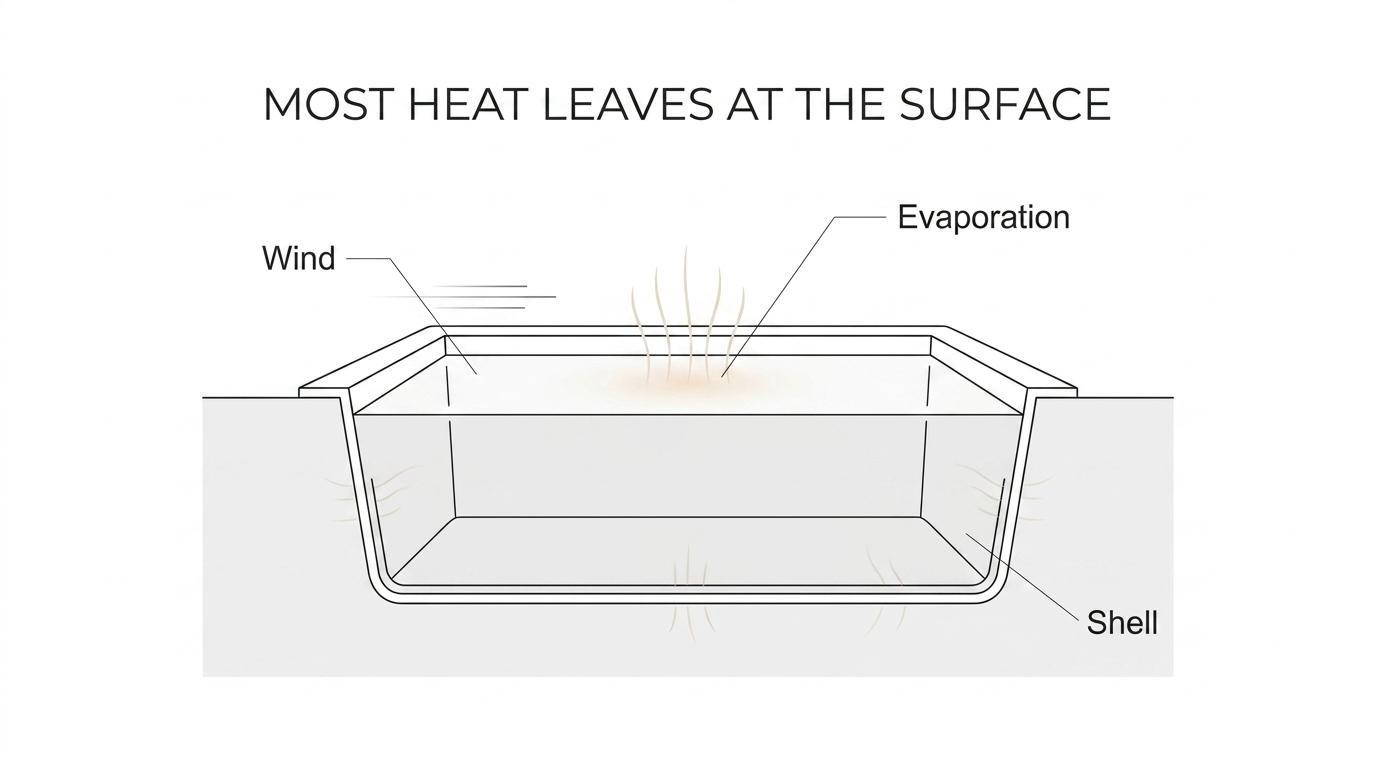
That changes the conversation.
If most heat leaves from the top, the smartest heat retention strategy is not just about what the pool is made from. It is about how the pool surface is managed day to day.
| Heat loss pathway | Typical share in heated pools | Why it matters |
|---|---|---|
| Evaporation | About 65% | Usually the biggest source of heat and water loss |
| Convection | Less than 20% | Wind moving across the surface carries warmth away |
| Radiation | About 10 to 15% | Heat radiates from warm water to cooler surroundings |
| Conduction | About 5% | Heat transfers through the shell and into the ground |
| Backwash and splash-out | About 3% | Warm water leaves the system and must be replaced |
This table helps put fibreglass into context. The shell matters, especially when the pool sits in the ground all year, but it is only one part of the energy picture.
Fibreglass pool shells and thermal conductivity
Fibreglass has a natural advantage as a pool shell material because reinforced composite materials tend to have low thermal conductivity. In plain language, they do not pass heat through as quickly as more conductive building materials.
Published data for fibreglass-reinforced thermoset polyester laminates shows thermal conductivity around 0.27 W/mK. That figure should not be treated as a universal number for every pool shell on the market, though it gives a useful indication of how this material family behaves. A lower conductivity means slower heat transfer through the pool wall and floor.
That slower transfer can help pool water stay warmer for longer, especially overnight when the ground around the pool is cooler than the water.
A fibreglass shell also tends to be a single, continuous moulded structure. That consistent construction can reduce thermal weak points that may be more common in systems built up from multiple layers, joints or masonry components. The effect is not dramatic enough to beat evaporation on its own, though it does support steadier heat retention over time.
For families who want a pool that feels comfortable more often, this matters. Better heat retention can reduce heater runtime, make shoulder-season swimming more appealing, and improve the value of every sunny afternoon.
Why fibreglass pools often feel warmer than expected
Part of the appeal is practical, not just technical. Fibreglass pools are often described as feeling quicker to warm and slower to cool than many people expect from an outdoor pool.
Some of that comes from the shell. Some comes from the way fibreglass pools are commonly installed and used. Many are paired with covers, efficient circulation, and compact or mid-sized designs that are easier to manage thermally than very large custom pools. A smooth gelcoat surface can also support efficient water circulation and easy cleaning, which helps owners keep the pool covered and maintained without extra fuss.
The point is not that every fibreglass pool is automatically warm.
The point is that fibreglass gives you a strong base for good heat performance, and the rest comes from how the pool is protected at the surface.
Pool covers make the biggest difference to heat retention
If there is one measure that changes the numbers most, it is the pool cover. Official Australian advice is very clear on this. Energy guidance for households states that covers can significantly reduce evaporation, and a good quality cover can cut heat losses from a heated pool by as much as 75%. It also notes that transparent bubble covers can reduce cooling by 3 to 4 degrees.
That is a far bigger gain than shell material alone can usually provide.
Northern Territory Government advice goes even further on the water-saving side, stating that pool covers can reduce evaporated water by up to 95%, with evaporation influenced by humidity, wind and water temperature. Since evaporating water carries heat away with it, reducing evaporation protects both temperature and running costs.
For homeowners, the message is very practical:
- Pool cover: The biggest single defence against heat loss
- Evaporation control: Less heat escaping from the surface
- Lower top-up demand: Less water lost to the air
- Heating efficiency: Less energy needed to bring water back to temperature
- Overnight performance: Better morning water temperature after cool evenings
A fibreglass pool with no cover can still lose warmth quickly. A fibreglass pool with a well-fitted cover can perform very differently.
Wind, humidity and shading affect fibreglass pool heat loss
Once evaporation is the focus, local conditions become much more important. Wind sweeping across the water surface accelerates heat loss. Dry air can do the same. Warmer water also evaporates faster than cooler water, which is one reason higher thermostat settings cost more than many owners expect.
That is why Australian planning and sustainability guidance often points to covers, shading and efficient heating choices rather than shell material alone. If heating is required, an efficient system is preferred, and if heating is not necessary, it is usually better avoided.
Shading is slightly more nuanced. Government guidance recommends shading as a way to reduce evaporation and water top-up. In real backyard settings, the best result often comes from balancing solar access with wind protection. Too much exposure can increase surface loss, while a well-placed fence, planting scheme or structure can calm the microclimate around the pool.
Key site factors include:
- Wind exposure
- Air humidity
- Water temperature
- Pool cover use
- Shade and shelter
- Frequency of night-time heat loss
Frameless glass fencing, landscaping and pool placement are often discussed for safety or aesthetics, though they can also influence how breezy the pool surface becomes. Even a modest reduction in wind can support better heat retention.
Fibreglass swimming pools compared with concrete for heat retention
This is where expectations need to stay realistic. Fibreglass can help hold heat longer, but no pool shell can fully offset an uncovered surface on a cool, windy night.
Still, when comparing construction types, fibreglass is often seen as thermally favourable because the shell is a composite rather than a dense, highly conductive mass. That means less heat transfer through the structure and into the surrounding soil. In day-to-day use, that can support a more stable water temperature.
Concrete pools have strengths of their own, especially for custom forms and finishes, though from a heat-retention perspective the shell is not usually working as much in your favour as a low-conductivity fibreglass laminate. The difference is often most noticeable when combined with a cover and efficient heating strategy.
A simple way to think about it is this:
- Fibreglass helps slow heat escape through the pool structure.
- Covers help stop the biggest losses at the surface.
- Good site planning protects the gains.
When those three work together, the pool feels easier to live with.
Practical heat-saving choices for fibreglass swimming pools
Homeowners do not need a complicated energy model to make smart decisions. A few well-chosen measures have an outsized effect on comfort and operating cost.
The first is choosing a shell material that does not give heat away too readily. Fibreglass does that well. The second is controlling evaporation with a quality cover. The third is limiting avoidable exposure to wind and unnecessary overheating.
A sensible setup often looks like this:
- Choose a well-fitted cover: This is the strongest move for retaining heat overnight
- Keep water temperature sensible: Every degree higher increases evaporation pressure
- Use efficient heating only when needed: Solar and other efficient systems reduce running costs
- Plan for shelter: Fencing, planting and structures can calm surface wind
- Think about sun access: Enough sunlight for comfort, enough protection to reduce loss
For families in Sydney and surrounding areas, these choices can make a pool feel more usable across more months of the year without pushing energy use too hard. That is especially true when the pool is part of a start-to-finish plan rather than treated as a shell alone.
What homeowners should take from the heat-retention question
The strongest answer is balanced, and it is encouraging.
Fibreglass swimming pools can hold heat for longer because the shell material transfers heat more slowly than many heavier construction materials. That is a real advantage, not a marketing flourish. Yet the biggest wins still come from controlling evaporation, since most pool heat loss occurs at the surface, not through the walls.
So if the goal is warmer water for longer, the best-performing approach is not one feature in isolation. It is a fibreglass shell, a proper cover, sensible heating choices, and a backyard layout that reduces wind exposure where possible.
That combination gives homeowners a pool that stays inviting with less effort, less wasted energy, and more confidence every time the cover comes off.
One Response