
If you own a home with a swimming pool or spa in NSW, a pool compliance certificate is more than a box to tick. It is a safety document with real impact on sales, leasing, and day-to-day responsibility as a pool owner.
Many homeowners assume that once a pool is listed on the NSW Swimming Pool Register, the property is ready for sale. That is not the case. Registration and compliance are separate matters. A registered pool can still fail inspection if the barrier, gate, signage, or non-climbable zone does not meet the rules.
For families preparing to sell, buy, or simply confirm that their pool area is safe, it helps to know what the certificate covers, how long it lasts, and which defects tend to slow the process down.
What a pool compliance certificate means in NSW
A pool compliance certificate in NSW confirms that the swimming pool or spa barrier met the required safety standards at the time of inspection. In practice, that usually means the inspector was satisfied that the child-resistant barrier, gate operation, clearances, and required signage complied with the applicable rules.
This matters because NSW pool owners must register their pool or spa, maintain a compliant barrier, keep gates and doors closed where required, and display an approved CPR sign. A certificate of compliance is valid for 3 years from the date of issue.
Registration alone does not prove that the barrier is compliant. That distinction catches many property owners off guard, especially when a sale is approaching.
Here is the basic difference:
- Pool registration
- Barrier compliance
- Inspection outcome
- Contract documentation
Pool compliance certificate NSW rules for selling or buying
When a property with a pool is sold in NSW, the contract needs more than proof of registration. The seller must include the Swimming Pool Register registration certificate and also one of the accepted supporting documents.
| Document | What it means | Typical use in a sale |
|---|---|---|
| Registration certificate | Confirms the pool is on the NSW register | Required |
| Certificate of compliance | Confirms the barrier passed inspection | Accepted for sale |
| Occupation certificate | Can satisfy sale requirements if recent and relevant | Accepted for sale |
| Certificate of non-compliance | Confirms the barrier did not meet requirements at inspection | Can be attached to contract in some cases |
If the required pool documentation is missing from the sale contract, the purchaser may have the right to rescind the contract within 14 days of exchange, unless settlement has already occurred. That makes early preparation very important.
A non-compliance certificate can also be used in a sale. If that happens, the buyer generally takes on the responsibility to rectify the listed defects and obtain compliance within 90 days from settlement, unless the pool has been assessed as posing a significant public safety risk. For sellers, that can affect buyer confidence and negotiation strength. For buyers, it can create urgent post-settlement work.
Pool inspection process in NSW
The inspection process is usually straightforward when it starts early. A registered inspector or local council inspects the pool barrier and either issues a certificate of compliance or records the reasons the pool did not pass.
Where the barrier does not meet the requirements, the details of non-compliance are entered on the register within the required timeframe. The owner can then rectify the defects and arrange a further inspection, or in some sale situations attach the non-compliance certificate to the contract.
A practical sequence often looks like this:
- Book early: arrange the inspection well before listing the property or exchanging contracts
- Check registration: confirm the pool is correctly recorded on the NSW Swimming Pool Register
- Attend to defects: fix any issues identified during inspection
- Re-inspect if needed: obtain the certificate of compliance once defects are rectified
ClearView Pool Solutions provides pool inspections and non-compliance certificates, which gives homeowners a clear path to identify issues early and act before a sale becomes time-sensitive.
What pool inspectors check during a compliance inspection
Most failed inspections come back to the barrier. The pool itself may be in excellent condition, yet the fence, gate, or surrounding objects can still lead to a non-compliant result.
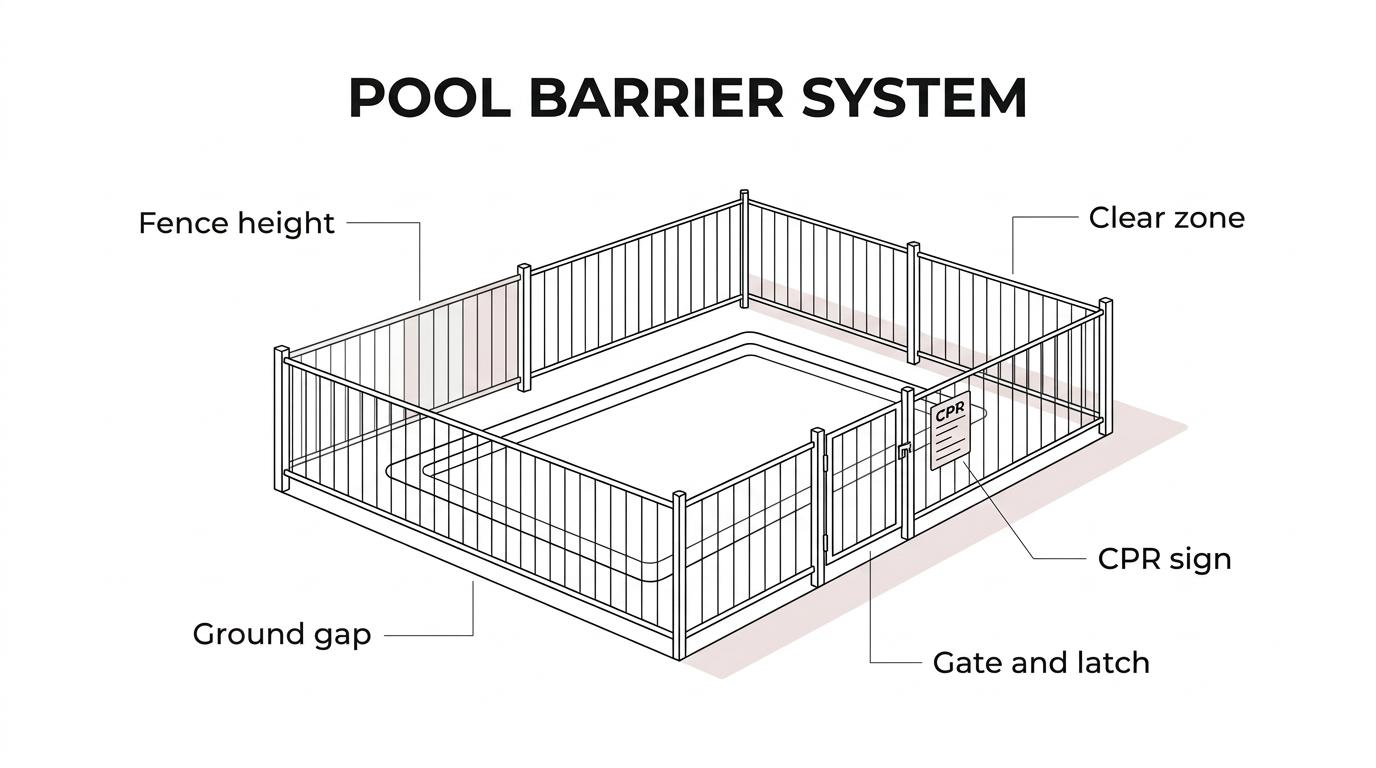
Inspectors generally assess the barrier as a complete safety system. That includes the height of the fence, the size of gaps, the way gates close and latch, the presence of climbable objects, and whether the pool area includes the required CPR signage.
Common inspection points include:
- Fence height: the barrier generally needs to be at least 1.2 metres high
- Boundary barrier height: where a boundary fence forms part of the barrier, it generally needs to be 1.8 metres high
- Ground clearance: gaps under the barrier must not be too large, with the common limit being 100 mm
- Gate operation: gates should close and latch properly without being propped open
- Non-climbable zone: a clear 900 mm zone must be free from climbable objects
- CPR sign: an approved CPR sign must be displayed and visible
The non-climbable zone is one of the most misunderstood parts of compliance. A fence may look secure, yet a nearby chair, pot plant, outdoor heater, tree branch, toy box, or barbecue can create an easy climbing point for a child. That is enough to delay approval.
Common issues that delay pool compliance approval
Some defects are obvious. Others are surprisingly easy to miss until an inspection is booked.
Gate problems are high on the list. A gate that drags on the ground, fails to self-close from every position, or has a faulty latch will often lead to a non-compliant result. This can happen through normal wear over time, especially where hinges have loosened or posts have shifted.
The second major issue is the non-climbable zone. Homeowners often focus on the fence panels and overlook what sits near them. Items that seem harmless in everyday use can become a compliance problem if they sit within the 900 mm zone.
A few recurring delay drivers are worth checking before the inspector arrives:
- pot plants near the fence
- outdoor furniture
- trees and overhanging branches
- kids’ toys
- ladders or storage items
- shrubs that create footholds
Signage is another common snag. The CPR sign must be present and in acceptable condition. Faded, damaged, or missing signage can hold up certification even when the barrier itself is in reasonable order.
Then there are measurement issues. Small gaps under the fence, slight changes in ground level, or a section of boundary fencing that does not meet the required height can all become barriers to approval.
Why early pool inspections save time and stress
A compliance inspection should not be left until contracts are being prepared. If defects are found, trades may be needed, replacement parts may need ordering, and a reinspection must be booked.
That is why NSW guidance encourages pool owners to contact a council or private certifier early when planning to sell or lease. A current certificate of compliance lasts 3 years, so arranging it in advance can make the sale process much smoother.
Early inspection helps in three ways.
First, it gives the homeowner time to fix defects properly rather than rushing through short-term repairs. Second, it reduces the chance of contract delays. Third, it gives sellers more control over the result, rather than shifting repair obligations to the buyer under a non-compliance pathway.
What sellers should do before putting a pool property on the market
Sellers benefit from taking a methodical approach. A quick check a few months before listing can make a major difference once solicitors begin preparing contract documents.
Start with paperwork. Confirm the pool is registered and that the details are current. Then review whether a valid compliance certificate or a relevant occupation certificate is already available. If not, book an inspection early.
After that, focus on the site itself. Walk the fence line slowly. Open and release each gate from different positions. Look for rust, loose hinges, warped panels, missing latch tension, or anything stored too close to the barrier.
A sensible seller checklist includes:
- Documents: confirm the registration certificate is available
- Certificate status: check whether a valid 3-year compliance certificate already exists
- Barrier review: inspect fences, gates, latches, and boundary sections
- Site clearance: remove climbable objects from the non-climbable zone
- Signage: replace missing or weathered CPR signs
- Inspection booking: arrange a professional inspection before marketing starts
Where the inspection identifies defects, the seller then has a choice: rectify the issues and seek compliance, or in some cases attach a non-compliance certificate to the contract. In many situations, rectifying first puts the property in a stronger position.
What buyers should check before exchange
Buyers should not assume that a sparkling pool area is compliant just because it looks modern or recently landscaped. Visual appeal and legal compliance are not the same thing.
Before exchange, ask whether the contract includes the required pool documentation. That means the registration certificate and one of the accepted supporting documents, being a valid compliance certificate, a relevant occupation certificate, or a non-compliance certificate where permitted.
If a non-compliance certificate is attached, buyers should read it carefully. The listed defects may seem minor, yet rectification costs can vary widely. A gate replacement, fence rework, glass panel adjustment, or boundary barrier upgrade can add up quickly, especially if several items need attention at once.
This is where a buyer should slow down and ask clear questions:
- What exact defects were listed?
- Are quotes available for rectification?
- Is any part of the barrier on a boundary likely to need significant work?
- Will the 90-day post-settlement timeframe be realistic?
- Is there any public safety concern that changes the usual process?
A pre-purchase pool inspection can add valuable clarity before contracts become binding.
When a certificate of non-compliance may still be useful
A non-compliance outcome is not the end of the road. In some situations, it provides a practical snapshot of what needs to be fixed and what the next steps should be.
For owners who are not yet ready to complete the repairs, it can define the scope of work. For sellers under time pressure, it may allow the transaction to proceed where the buyer accepts responsibility after settlement, subject to the NSW rules.
That said, a non-compliance certificate should never be treated casually. It signals that the barrier was not compliant at inspection, and it creates a time-sensitive follow-up process. Buyers need to be ready for that responsibility. Sellers need to recognise that it may affect value, negotiation, and buyer confidence.
ClearView Pool Solutions provides inspections and non-compliance certificates, helping homeowners identify defects clearly and move toward a compliant result with less uncertainty.
Choosing a pool inspector in Sydney and surrounding areas
A good pool inspector does more than point out faults. The value lies in clarity, accuracy, and a practical reading of the site conditions.
Homeowners generally want to know three things quickly: whether the pool is compliant, what is stopping approval, and what should be done next. That is especially true before a sale or purchase, where timing matters almost as much as the inspection result itself.
For Sydney homeowners, ClearView Pool Solutions offers swimming pool inspections as part of a broader start-to-finish pool service. That includes support for homeowners who need a compliance inspection, as well as those who require a non-compliance certificate before taking the next step.
A pool area can look finished and still miss the mark on safety. Getting it checked early is often the smartest move you can make.